A missing or damaged cap is one of the simplest problems to cause the most damage — rain, snowmelt, and animals all get a direct path into your flue.
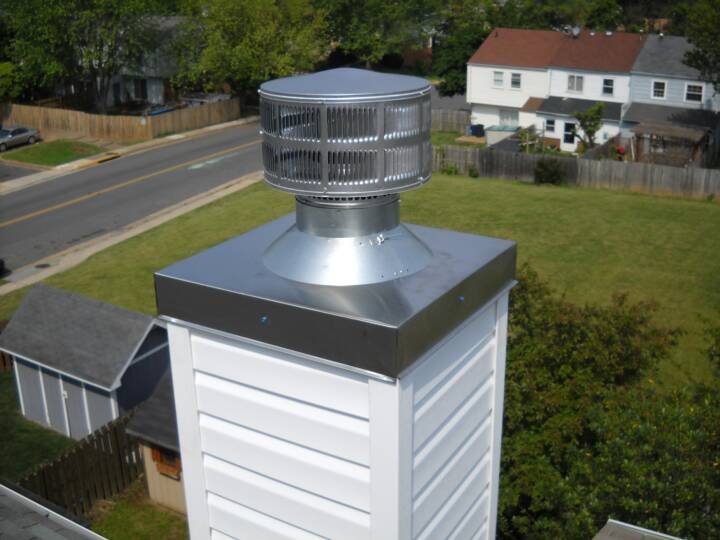
Exact diameter and shape confirmed before ordering the right cap for your chimney.
Rusted, bent, or missing caps removed and disposed of before the new one goes on.
Durable materials sized specifically to your flue, not a one-size-fits-all fit.
Keeps animals and debris out while still allowing proper draft through the flue.
Fastened to withstand Minnesota wind without rattling loose or blowing off.
A single cap sized correctly for chimneys serving more than one flue.
Visible from the ground on many homes, and an easy thing to overlook until something goes wrong.
Metal that's degraded no longer seals properly against wind-driven rain and snow.
Scratching or chirping usually means something got past a missing or damaged cap.
Often traces directly back to a missing or failed cap rather than the crown or flashing.
A sign the cap doesn't fit properly, is loose, or has partially come off.
Flue shape and chimney configuration drive the cost more than the cap itself.
No service call fee, no obligation. Written quote before any work begins.
Round, square, and rectangular flues each need different cap types.
Multi-flue chimneys may need one larger cap or several smaller ones.
Stainless steel versus copper affects both upfront cost and lifespan.
Taller or hard-to-reach chimneys add time to the installation.
Tell us what you're seeing — no cap, animal sounds, or water.
We measure your flue and recommend the right cap.
Old cap removed, new cap fitted and securely mounted.
We confirm it's secure and back it for three years in writing.
It depends on flue diameter, shape, the number of flues, and material choice. We give a free on-site estimate with a written quote before any work begins.
A cap covers just the individual flue opening. A chase cover is the larger metal panel that covers the entire top of a factory-built chimney chase, with the flue pipe passing through it. Many chimneys need both.
Yes. An unused flue still needs a cap to keep out water, debris, and animals looking for a place to nest — an open flue is actually an easier target for wildlife than one that's regularly swept and used.
Stainless steel and copper both hold up well to freeze-thaw cycles and road salt in the air. Copper costs more upfront but can last significantly longer and develops a protective patina over time.
Yes, a properly fitted cap with mesh screening is the single most effective way to keep raccoons, squirrels, and birds out of a flue. Most animal entry problems trace back to a missing or damaged cap.
Most single-flue installations take well under an hour once we're on the roof. Multi-flue chimneys or custom-sized caps can take a bit longer.
Roughly 40 miles out from Minneapolis and St. Paul.
Free on-site estimate, written quote, no obligation. Next-day scheduling across the Twin Cities metro.
No commitment · No service call fee · Same-day available