
Smoke in the room is almost never just "a dirty chimney" — we diagnose the actual cause, which is often something nobody thinks to check.
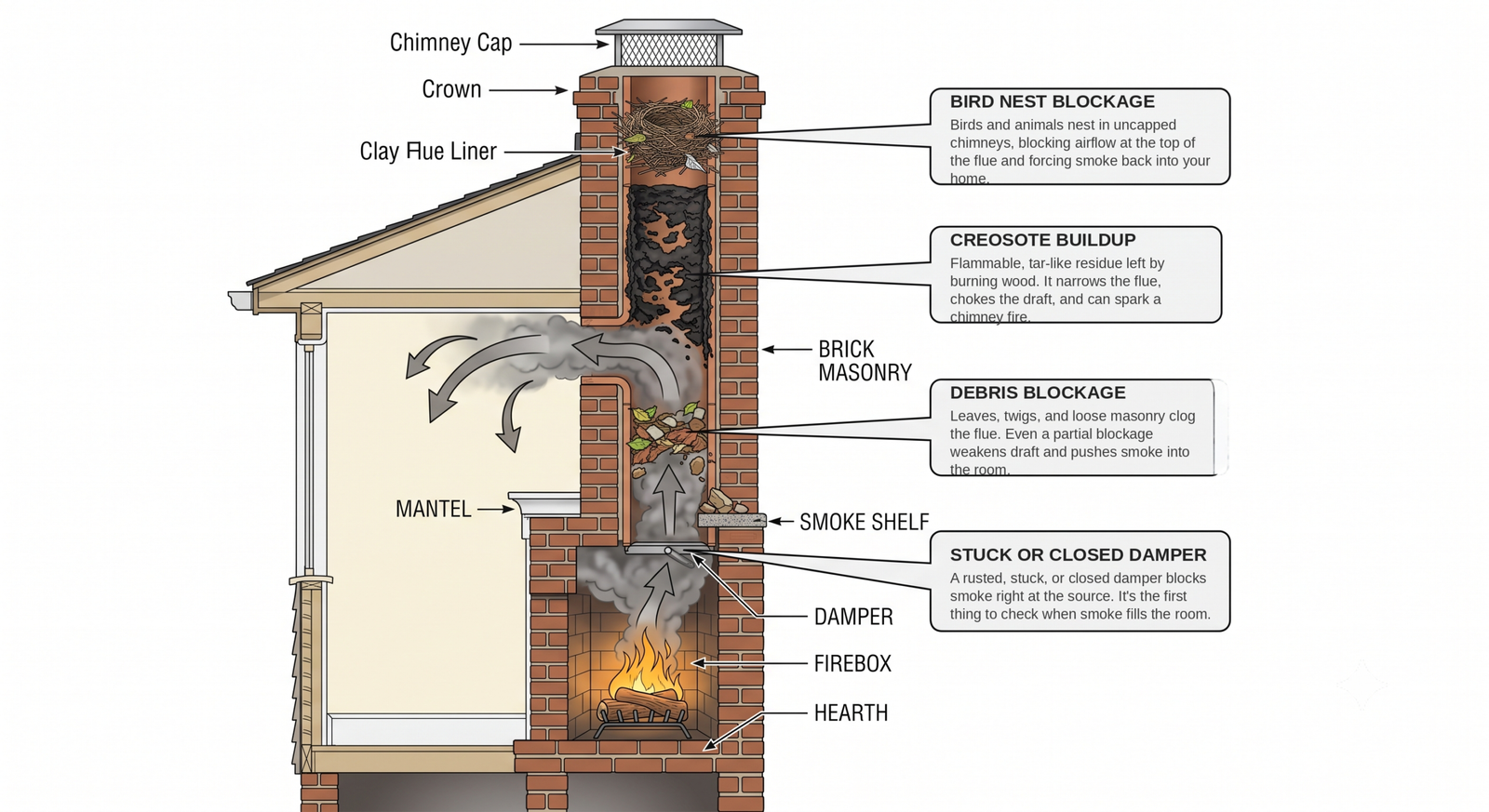
Six causes cover most smoke and draft complaints we see across the metro.
Buildup inside the flue physically restricting airflow.
A tight house that can't supply the air the flue needs to draft properly.
A mechanical issue preventing the damper from allowing proper airflow.
Height relative to the roofline that affects draft physics from the start.
Bath fans, range hoods, or a furnace competing for the same limited air supply.
Oversized or undersized flues relative to the appliance both cause draft problems.
The most obvious and common complaint, and the one that prompts most calls.
New windows, insulation, or weatherstripping changed the home's air balance.
A bath fan or range hood on making it worse is a classic make-up air sign.
Downdraft pulling air, and odor, back into the house between uses.
Points to a structural or sizing issue from the original build rather than wear over time.
The fix depends entirely on which of the six causes is actually behind it.
No service call fee, no obligation. We identify the cause before quoting a fix.
Some causes are obvious on inspection, others take more investigation to isolate.
A damper adjustment costs far less than height or make-up air corrections.
Physical modifications to height or structure require scaffolding.
Wood-burning, gas, and insert appliances each have different draft requirements.
Tell us when it happens — every fire, or only sometimes.
We test airflow and identify the actual cause.
Right-sized solution, from a damper adjustment to a make-up air vent.
We test the fix and confirm it before we call the job done.
Intermittent smoke is often tied to which fans are running, wind direction, or outdoor temperature. Make-up air problems in particular tend to show up only under certain conditions rather than every single time.
Only if the cause is actually a blockage. If the real issue is make-up air, damper function, or chimney height, sweeping won't change anything, which is why diagnosis matters before jumping to a sweep.
A fire needs a steady supply of air to burn and draft properly. In a tightly sealed modern home, there may not be enough air readily available, so the fireplace effectively competes with the house for air — and often loses, pushing smoke back into the room instead of up the flue.
Yes, and it's more common than people expect. Sealing up a home for energy efficiency reduces the air naturally available to the fireplace, which can turn a fireplace that worked fine for years into one that suddenly smokes.
Diagnosis itself is free. The cost depends on what we find — a simple damper adjustment is inexpensive, while make-up air or structural corrections cost more. We'll always explain the cause and the fix before charging anything.
Yes. A chimney that's too short relative to the roofline or nearby structures can create turbulent airflow that pushes smoke back down. This is a structural issue from the original build, and correcting it usually requires height modification rather than a simple repair.
Roughly 40 miles out from Minneapolis and St. Paul.
Free on-site diagnosis, written findings, no obligation. Next-day scheduling across the Twin Cities metro.
No commitment · No service call fee · Same-day available